 Andy Biotech
1 / 1
| Shikimic Acid Technical Data Sheet | |
| Sense Index | |
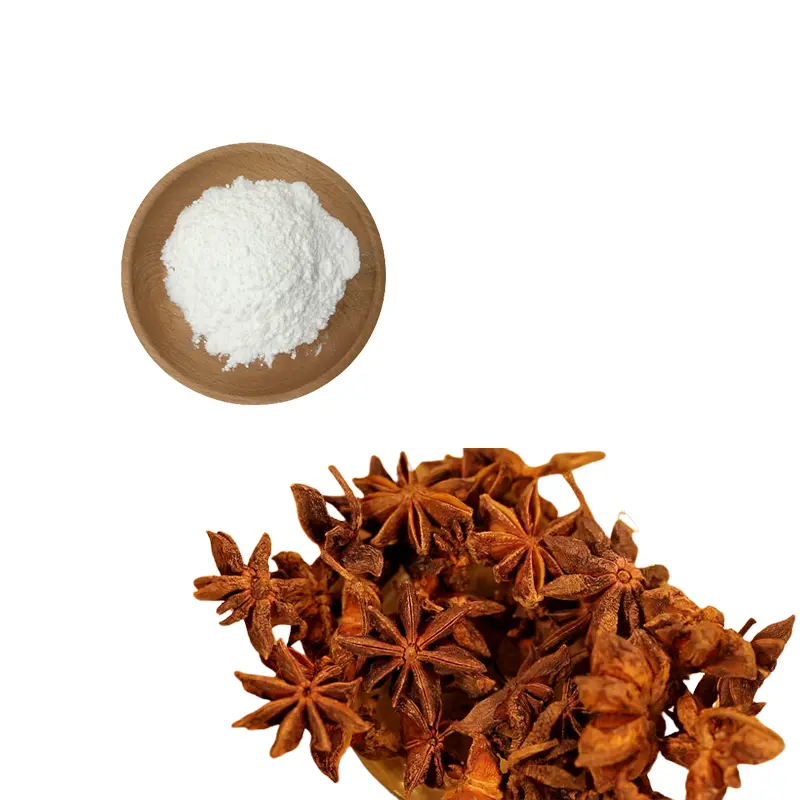
| Appearance | White powder |
| Odor & Taste | Characteristic |
| Physical-chemical Index | |
| Shikimic acid (HPLC) | 98% Min |
| Particle Size | 98% pass 80 mesh |
| Loss on drying | 5% Max |
| Ash | 5% Max |
| Heavy metals | 10ppm Max |
| Lead | 2ppm Max |
| Arsenic | 2ppm Max |
| Mercury | 0.1ppm Max |
| Cadmium | 1ppm Max |
| Hygienic Index | |
| Total plate count | 1,000cfu/g Max |
| Mold & yeast | 100cfu/g Max |
| Enterobacteriae | 10cfu/g Max |
| E.Coli | Absent in 10g |
| Salmonella | Absent in 25g |
| Statements: Non-Irradiated, Non-GMO | |
| Packaging: 1kg/aluminium foil bag, 25kg/drum (37*37*50cm). | |
| Shelf Life: 24 months stored in original packaging away from the light, and under the optimal temperature 10~25℃. | |
Shikimic Acid is a naturally occurring cyclohexene-type organic acid with the chemical formula C₂H₁₀O₅. It is widely found in plants such as star anise (Illicium verum), ginkgo, and conifers. At room temperature, it appears as a white crystalline powder, soluble in water, and serves as a key intermediate in the plant biosynthetic pathway for aromatic amino acids (e.g., phenylalanine, tyrosine). Traditionally extracted from star anise fruits, modern production also utilizes microbial fermentation (e.g., engineered E. coli). As a vital precursor in synthetic biology and medicinal chemistry, shikimic acid holds an irreplaceable position in the pharmaceutical field, particularly in antiviral drug synthesis.
The core efficacy of shikimic acid lies in its role as a critical biosynthetic precursor. In pharmaceuticals, it is the indispensable starting material for synthesizing the anti-influenza drug oseltamivir (Tamiflu), converted through multiple chemical steps into a neuraminidase inhibitor. In plants, the shikimic acid pathway directly regulates the synthesis of defense compounds (e.g., salicylic acid) and growth hormones. Additionally, studies suggest shikimic acid itself exhibits certain anti-inflammatory, antioxidant, and antithrombotic activities, though research on its direct bioactivity remains preliminary. Currently, its primary value centers on being a key pharmaceutical intermediate, supporting the global supply chain for antiviral drug production.
Shikimic acid is primarily used in the pharmaceutical industry as a crucial raw material for synthesizing anti-influenza drugs like oseltamivir and zanamivir. In agrochemicals, it serves as a precursor for developing eco-friendly herbicides and plant growth regulators. The food industry may employ it as a natural preservative or intermediate in flavor synthesis. In scientific research, it is used as a model molecule for studying plant secondary metabolism and microbial synthetic pathways. In recent years, its applications have expanded into developing novel anti-infective drugs, anticancer drug precursors, and green manufacturing based on synthetic biology, showcasing broad potential for future growth.
Shikimic Acid is naturally found in plants like star anise (Illicium verum), ginkgo, and conifers. It is traditionally extracted from star anise fruits, but modern production also utilizes microbial fermentation, such as engineered E. coli, to meet demand.
It is an indispensable starting material and precursor for synthesizing key anti-influenza drugs, including oseltamivir (Tamiflu) and zanamivir, making it vital to the global antiviral drug supply chain.
According to the technical data sheet, it comes as a white powder with a HPLC purity of 98% minimum, a mesh size of 98% passing 80 mesh, and strict limits on moisture, ash, and heavy metals (e.g., Lead ≤ 2ppm, Arsenic ≤ 2ppm).
Yes, it is used in agrochemicals as a precursor for eco-friendly herbicides and plant regulators, in the food industry as a preservative or flavor intermediate, and in scientific research to study metabolic pathways.
Shikimic Acid has a shelf life of 24 months. It should be kept in its original packaging, protected from light, and stored at an optimal temperature range of 10 to 25℃.
Yes, our Shikimic Acid is certified as Non-Irradiated and Non-GMO, complying with standard hygienic indexes for safe industrial utilization.